
Perfumers Alcohol Supplier in Dubai
The foundation of every luxury fine fragrance. Scent Bazaar provides technical-grade perfumers alcohol formulated specifically for optimal scent projection, stability, and fast skin absorption.
Technical-Grade Fragrance Solvents
Perfumers alcohol is a high-purity, cosmetic-grade ethanol used as the carrier solvent in spray perfume manufacturing. It is typically 96% ABV or above, completely odourless, and fast-drying — making it the standard base for Extrait de Parfum, Eau de Parfum, Eau de Toilette, and Eau de Cologne concentrations. In the UAE, perfumers alcohol is also used to dilute traditional oud-based attars for spray application, and as a base for room and linen sprays.
While concentrated fragrance oils provide the soul of a perfume, the carrier solvent dictates how that soul behaves. Scent Bazaar is a trusted perfumers alcohol supplier in Dubai, providing the highly specialized solvent base required to turn concentrated oils into retail-ready Eau de Parfum (EDP) and Eau de Toilette (EDT) sprays.
Standard pharmacy-grade rubbing alcohol cannot be used in fine perfumery. Our technical-grade perfumers alcohol is chemically engineered to minimize the harsh "alcohol burn" upon initial spray. This allows the delicate top notes of your customized fragrance to present themselves immediately rather than being masked by strong chemical odors.
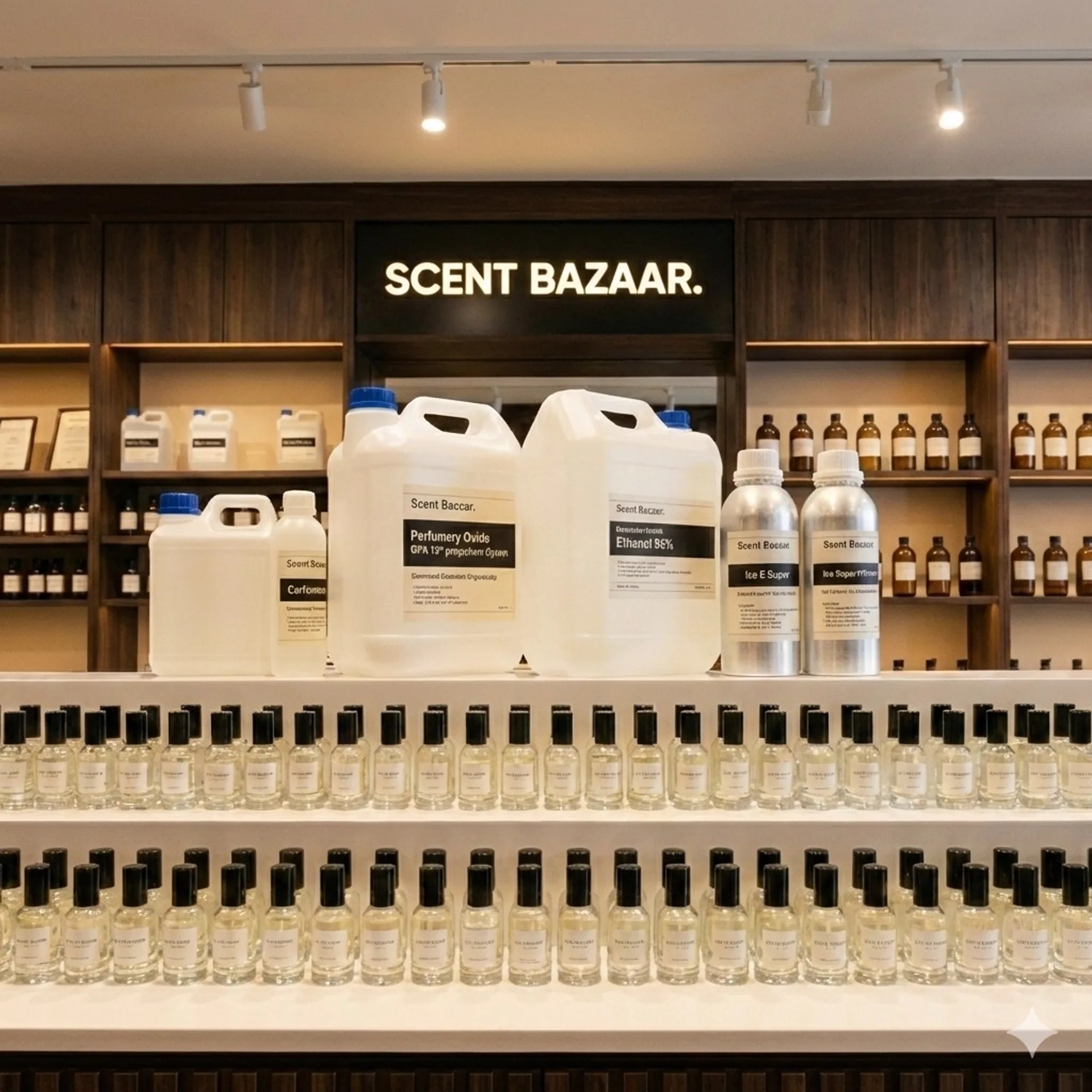
Whether you require a single 5-liter jerry can for a boutique artisan lab or multiple 200kg drums for factory-level manufacturing, our Dubai facility ensures constant supply chain reliability.
Explore Fragrance Oils to Blend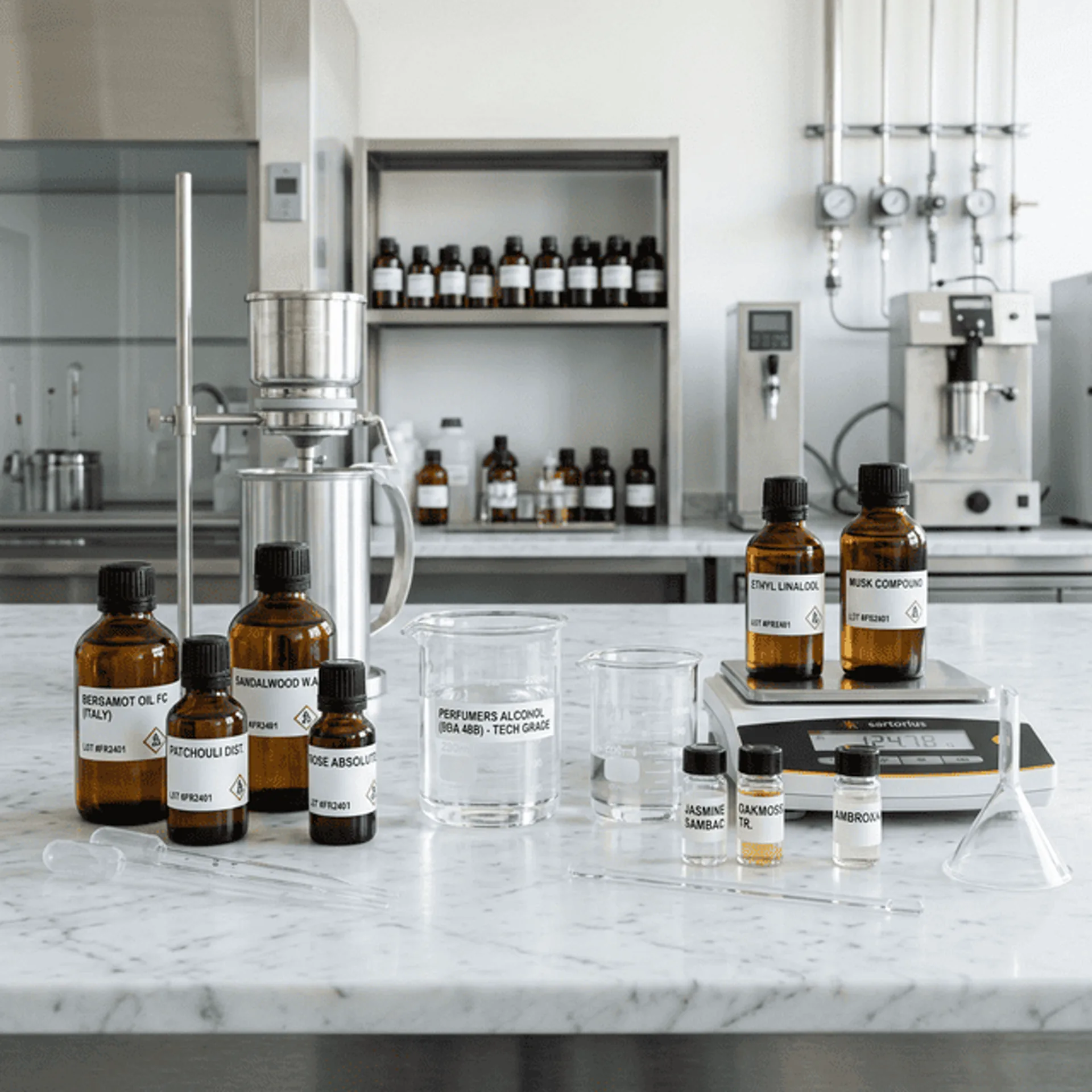
Formulated for Superior Sillage & Fixation
Creating a long-lasting perfume requires more than just high oil concentration. Our perfumers alcohol is pre-formulated with advanced chemical fixatives to bind the fragrance molecules directly to the skin, drastically improving the perfume's 'sillage' (the trail left behind) and overall longevity.
- Evaporation Control: The addition of specialized retardants slows down the evaporation of the alcohol, ensuring the base notes (like Vanilla, Musk, and Oud) linger on the skin for 12+ hours.
- Chilled Filtration Compatibility: Our solvents are perfectly compatible with our automated perfume filling and cold filtration processes, guaranteeing crystal clear liquids with zero cloudiness.
- Denatured for Safety: To comply with global regulatory standards, our perfumers alcohol is strictly denatured, making it unfit for consumption while remaining 100% skin-safe and suitable for commercial fragrance production.
Handling Hazardous Materials Logistics
Exporting high-proof alcohol internationally is a complex logistical challenge due to its highly flammable nature. As an experienced supplier based in Dubai, Scent Bazaar manages the entire regulatory pipeline.
From issuing Material Safety Data Sheets (MSDS) and Certificates of Analysis (COA) to executing DG (Dangerous Goods) declarations at Dubai ports, we ensure your bulk shipments clear customs efficiently, whether transported via sea freight or specialized air cargo.
For brands utilizing our private label perfume services, we handle the alcohol formulation and blending entirely in-house, meaning you simply receive the fully stabilized, boxed, and safe-to-ship final retail product.
Frequently Asked
Questions
Everything you need to know before placing an order or visiting our Deira showroom.
Why must I use perfumers alcohol instead of standard pharmacy alcohol?
Pharmacy rubbing alcohol is isopropyl alcohol — a solvent with a sharp, harsh chemical odour that will overwhelm and distort even the finest fragrance oil, making it entirely unsuitable for perfume production. Perfumers alcohol is a specially denatured ethanol that is near-odourless when dry on the skin, allowing every note in your fragrance oil to project cleanly and accurately. Beyond odour, the chemistry is fundamentally different: ethanol evaporates at a rate that carries fragrance molecules with it in the correct sequence — top notes first, then heart, then base — which is how fine perfume is designed to perform. Isopropyl alcohol evaporates differently and binds poorly with aromatic compounds. For any product where the scent experience matters — eau de parfum, cologne, body mist, or room spray — perfumers alcohol is the only appropriate carrier.
Does your alcohol already contain fixatives?
Yes. Our technical-grade perfumers alcohol is pre-formulated with industry-standard chemical fixatives — compounds such as isopropyl myristate or diethyl phthalate alternatives — that improve the binding between the fragrance oil and the alcohol carrier. Fixatives serve two functions: they slow the overall evaporation rate of the alcohol, extending the time the fragrance remains perceptible on skin, and they help anchor the heavier base-note molecules that would otherwise be lost too quickly. This means your finished perfume will have improved longevity and better fragrance development across all three scent layers — top, heart, and base. If you are using our perfumers alcohol straight from the container, you do not need to add any additional fixative compounds unless your formulation specifically requires a higher concentration for an ultra-long-wear product line.
What is the correct ratio to mix fragrance oil and alcohol?
The correct ratio depends on the product concentration you are producing. An Eau de Cologne (EDC) uses 3% to 5% fragrance oil in alcohol — light and refreshing, suited to daily wear. An Eau de Toilette (EDT) runs at 8% to 12%, offering moderate projection and a 3 to 4 hour wear time. An Eau de Parfum (EDP) uses 15% to 20% oil, delivering stronger sillage and longevity of 5 to 7 hours. An Extrait de Parfum — the most concentrated format — pushes oil concentration to 25% or higher, producing a rich, intimate scent that lasts all day. After blending, we recommend macerating your finished perfume in a sealed bottle for a minimum of 48 hours before use, to allow the oil and alcohol molecules to fully integrate.
Can you export bulk drums of alcohol safely?
Yes. Scent Bazaar is an experienced exporter operating out of Dubai, and we handle all Dangerous Goods (DG) documentation, MSDS filings, UN packaging certification, and hazard-grade labelling required for the safe international shipment of bulk ethanol by sea or air freight. Perfumers alcohol is classified as a flammable liquid under UN 1170 and requires specific documentation, packaging standards, and carrier approvals that we manage entirely on your behalf. We currently ship to over 50 countries, including markets across the GCC, Africa, Europe, and South and Southeast Asia. Our logistics process ensures full compliance with IATA regulations for air freight and IMDG code requirements for ocean freight. Buyers in import-regulated markets can request country-specific documentation in advance to facilitate smooth customs clearance at the destination port.
Is your perfumers alcohol suitable for making room sprays and linen mists?
Yes. Our technical-grade perfumers alcohol is the industry standard carrier for room sprays, linen mists, fabric fresheners, and pillow sprays. The near-odourless ethanol base carries fragrance oil evenly in suspension, atomises cleanly through a fine-mist pump nozzle, and dries rapidly on fabric and surfaces without leaving a sticky residue or water mark. For a standard room spray, we recommend blending 5% to 10% fragrance oil with 90% to 95% perfumers alcohol — at this ratio, the spray disperses immediately and fills a room quickly. For linen mists intended for direct fabric application, keeping the oil concentration at 5% or below avoids any risk of staining delicate fabrics. Our perfume oil catalogue of over 2,000 compounds includes fresh, clean, and floral accords that are particularly well suited to home fragrance spray applications.
Do you supply alcohol formulated for Islamic-compliant and halal-certified products?
Yes. We supply specially denatured perfumers alcohol formulated to meet halal certification requirements and Islamic compliance standards — an essential consideration for fragrance brands targeting the GCC, Southeast Asia, North Africa, and other Muslim-majority markets. The halal compliance of perfumers alcohol relates primarily to the source and denaturant chemistry used; our halal-designated formulation uses approved denaturant compounds and ethanol derived from non-prohibited sources. Each batch is supplied with the appropriate halal certification documentation and an MSDS confirming the formulation details. This is particularly important for brands selling through GCC retail chains, Islamic-certified e-commerce platforms, or exporting to markets in Indonesia, Malaysia, and Pakistan, where halal credentials are often a formal retail listing requirement rather than simply a consumer preference.
What sizes is perfumers alcohol available in?
We supply perfumers alcohol across four container formats to suit different production scales. Five-litre jerry cans are ideal for startups, product development testing, and small-batch artisan fragrance makers who need a manageable, cost-effective entry point. Twenty-five-litre drums suit growing fragrance brands producing regular runs of room sprays, colognes, or body mists. Two-hundred-litre steel drums are supplied to industrial fragrance manufacturers, contract filling facilities, and large-scale perfume production houses in the UAE and GCC. For buyers with very high volume requirements, full tanker supply can be arranged through our logistics partners. All container formats are supplied with DG-compliant hazard labelling, MSDS documentation, and batch traceability information as standard. International export across all container sizes is handled with full Dangerous Goods classification appropriate to the destination country's import regulations.
Does perfumers alcohol have an expiry date?
Perfumers alcohol stored correctly in sealed containers has a shelf life of approximately 2 to 3 years from the production date. The key storage requirements are straightforward: keep containers in a cool, dark, well-ventilated location away from direct sunlight, heat sources, and ignition risks. Exposure to heat above 30°C or repeated opening and closing of the container will accelerate evaporation and, over time, oxidation — both of which gradually degrade the carrier's performance. Once you have opened a container, we recommend decanting what you need and resealing the remainder promptly. All containers from Scent Bazaar arrive fully sealed, labelled with the batch number and production date, and accompanied by an MSDS that includes storage guidance and a recommended shelf-life statement. This batch traceability is particularly useful for brands managing raw material stock rotation in a production environment.
What is the difference between denatured and undenatured ethanol for perfumery?
Undenatured ethanol is pure food-grade alcohol and is subject to heavy excise duty and strict regulatory controls in most countries because it is consumable. Using undenatured ethanol in perfume production is legal but commercially prohibitive due to its cost. Denatured ethanol — the basis of perfumers alcohol — has small quantities of bittering or aversive agents, such as denatonium benzoate, added to render it undrinkable. This removes it from excise classification entirely, making it dramatically cheaper and far easier to import, export, and use commercially. Despite denaturation, the alcohol retains its near-odourless character when dry and remains fully compatible with all standard fragrance compounds, aroma chemicals, and essential oils used in fine perfumery. The denaturation has no effect on fragrance performance — which is precisely why denatured perfumers alcohol is the global industry standard for commercial fragrance manufacturing.
Can perfumers alcohol be used for making hand sanitiser or cleaning products?
No, and we strongly advise against it. While high-purity ethanol is indeed the active ingredient in hand sanitisers, our perfumers alcohol is a specialised formulation designed exclusively for fragrance applications. It contains fixatives, evaporation retardants, and denaturant compounds that are not appropriate — and in some jurisdictions not permitted — in products intended for direct skin sanitisation or food-surface cleaning. Sanitiser-grade ethanol must meet specific pharmacopoeial purity standards (such as USP or BP grade) and must not contain the fixative additives present in our product. Using our perfumers alcohol for sanitiser production could result in a product that fails regulatory testing or causes skin irritation at the concentrations required for antimicrobial efficacy. For sanitiser or cleaning product manufacturing, a different ethanol grade entirely is required. Our team can advise on appropriate sourcing if needed.