
Published: · Last updated:
Searching for perfume oil suppliers Dubai usually starts with a simple question: who has the best oils? For B2B buyers, that is the wrong first question. The better question is: which supplier can consistently deliver the right oil, at the right MOQ, with the right paperwork, for the right product format and target market?
Dubai is one of the strongest fragrance trading hubs in the region. Buyers can source concentrated perfume oils for fine fragrance, roll-ons, bakhoor, air fresheners, candles, soaps, detergents, and private label perfume projects. But supplier quality varies sharply. Some vendors are excellent at fast local trading but weak on repeatability. Others have attractive pricing but cannot produce batch-level documentation when a customs broker or retailer asks for it. Some can supply designer-inspired fragrance oils in volume, but struggle when you need application guidance, allergen declarations, or a custom brief translated into a workable formula.
The core commercial truth: the cheapest drum or bottle is rarely the cheapest landed cost if it causes reformulation delays, shipment holds, label problems, or inconsistent repeat orders.
This guide breaks down what sophisticated buyers should evaluate, how MOQs differ across supplier types, what compliance documents matter in practice, and how to think about sourcing from UAE suppliers compared with Indian and Chinese manufacturers. It also explains where Scent Bazaar fits in that landscape for brands that want a Dubai-based partner with technical guidance instead of a transactional seller.
What makes a perfume oil supplier worth shortlisting?
Buyers evaluating perfume oil suppliers in Dubai should assess at least six categories before requesting prices. This is where a large portion of procurement mistakes happen. Businesses often compare only fragrance selection and unit price, then discover the supplier is weak on stability, shipping readiness, or account management.
1. Product fit
Not every oil works equally well across all applications. A supplier should ask whether you are making fine fragrance, oil perfume, bakhoor, body care, candles, diffuser products, or detergent lines. The correct oil choice depends on base compatibility, volatility, flash point, and intended dilution.
2. Documentation depth
At commercial level, buyers should expect at minimum MSDS, COA, and when relevant allergen declarations. Export buyers may also need flash point data, IFRA-related usage guidance, and Dangerous Goods paperwork depending on the route and carrier.
3. MOQ flexibility
Startups, hotels, and new private label brands often need low trial MOQs before scaling. Larger factories need suppliers that can move from sample quantities to multi-kilo or drum supply without changing quality profile.
4. Repeatability
A good sample means little if repeat batches drift. Ask how the supplier manages batch control, sourcing continuity, and fragrance profile consistency over time, especially for your best-selling SKUs.
5. Communication quality
Serious suppliers answer commercial questions clearly: lead times, sample policy, private label capability, production slots, export preparation, and payment terms. Vague replies usually predict operational friction later.
6. Commercial support
If you are launching a fragrance brand, you may need bottles, alcohol, filling, custom blending, or labeling support. A supplier that covers adjacent steps can reduce coordination risk and shorten time to launch.
For fragrance brands specifically, supplier evaluation should also include whether the team understands scent architecture and performance language. If you say you need a brighter opening, better dry-down, lower sweetness, stronger oud presence, or better lift in alcohol, the supplier should understand what those instructions mean commercially. That is one reason technically grounded fragrance houses often outperform pure trading desks in long-term B2B relationships.
MOQ comparison: how supplier models affect commercial risk
MOQ is not just a purchasing detail. It shapes how quickly you can validate a fragrance, how many variants you can test, and how much dead stock risk sits on your balance sheet. Below is a practical comparison of the supplier models most buyers encounter when sourcing perfume oils for Dubai and export markets.
| Supplier model | Typical MOQ | Best for | Main watchout |
|---|---|---|---|
| Dubai trading house with local stock | Low to medium. Often sample size, 100ml, 500ml, 1kg, then higher tiers. | Brands testing multiple scents, hotel projects, fast replenishment, export buyers needing local coordination. | Quality varies widely. Some local traders resell without deep technical support. |
| Dubai supplier with formulation and adjacent services | Low on stocked oils, scalable on custom work. | Private label perfume, custom blending, launches needing oil plus packaging or filling support. | You need to confirm which items are stocked and which are made to order. |
| Indian manufacturer or attar specialist | Medium. Usually better at case-size or kilo-level volumes than tiny split quantities. | Traditional profiles, attars, oriental families, mid-volume importers, buyers comfortable managing overseas coordination. | Lead times, freight planning, and documentation standards vary supplier to supplier. |
| Chinese industrial fragrance producer | Medium to high, especially for factory-direct production. | Large industrial buyers with structured QC processes and predictable demand. | Formula translation, performance alignment, and compliance interpretation need tighter oversight. |
In practice, many smaller brands make the mistake of buying as if they are already a large factory. They accept large MOQs because the price per kilo looks attractive. Then they discover two issues: first, the scent needs adjustment; second, they cannot move through the volume quickly enough. For new launches, low-MOQ access is a strategic advantage because it lets you test multiple directions without tying cash up in slow-moving inventory.
For most emerging fragrance brands, the ideal supplier is not the lowest-quoted one. It is the one that lets you test quickly, document properly, and scale the winner without changing scent profile.
Compliance requirements buyers should check before placing an order
If you are buying perfume oils for commercial use, compliance is part of the product, not an optional extra. This is especially true if you plan to export, sell through formal retail channels, register finished products, or work with hotels and corporate buyers. A supplier who says documentation can be “arranged later” is increasing your risk.
For most B2B perfume oil transactions, buyers should ask about the following:
- MSDS: essential for safe handling, storage, and many freight processes.
- COA: confirms batch-specific quality information and helps with internal QC records.
- Allergen declaration: especially relevant for cosmetic products and export markets with formal ingredient disclosure requirements.
- Flash point data: important for transport classification and packaging decisions.
- IFRA-related usage guidance: helps buyers understand suitable application rates in finished products.
- Dangerous Goods support: required for many international shipments depending on oil type, route, and mode of transport.
Buyers should also understand the difference between documentation quality and documentation existence. Some suppliers can send a generic PDF pack on request, but the documents may be old, incomplete, or not aligned with the actual batch supplied. Others maintain a cleaner documentation process and can prepare records matched to the delivered goods. For regulated buyers, that difference matters.
For UAE and GCC retail
Expect buyer scrutiny on basic safety documentation, labeling support, and consistency. If you are building a brand, you need supplier records clean enough to support packaging decisions and retailer due diligence.
For export markets
Expect higher paperwork sensitivity. Even when the oil itself is sound, incomplete freight or compliance files can delay customs release, trigger carrier rejection, or force relabeling at the destination.
A good perfume oil supplier in Dubai should be comfortable discussing this without sounding defensive. Documentation is not a burden for a serious supplier. It is part of the service promise.
UAE vs Indian vs Chinese perfume oil suppliers: which sourcing route fits your business?
There is no universal winner across all supplier origins. Each route has strengths. The right answer depends on your product type, reorder speed, quality tolerance, and how much procurement complexity your team can absorb.
UAE suppliers
Dubai-based suppliers are strongest when the buyer values speed, accessibility, and commercial coordination. You can often review samples faster, discuss briefs in real time, and source adjacent inputs such as bottles, alcohol, caps, pumps, or filling support from the same ecosystem. This reduces the operational drag that comes with coordinating multiple vendors across multiple countries.
UAE suppliers are especially attractive for fragrance startups, hotel scent projects, private label buyers, and regional traders who need smaller or staged ordering. The premium you sometimes pay on unit price can be justified by lower lead times, lower MOQ risk, and easier troubleshooting.
Indian suppliers
Indian fragrance and attar supply remains highly relevant for buyers looking for traditional oil profiles, broader oriental references, and strong value at mid-volume scale. Many buyers sourcing for bakhoor, attar, incense, or classic Middle Eastern profiles keep Indian supply on their shortlist for exactly this reason. The key caveat is variation: some suppliers are highly sophisticated, while others are harder to manage on specification discipline and export-readiness.
If you buy from India, success often depends on how clearly you lock the fragrance brief, the documentation expectation, and the sampling process before confirming the main order. Buyers who treat the relationship casually tend to encounter more drift.
Chinese suppliers
Chinese manufacturers can make sense for large industrial buyers or companies sourcing fragrance inputs alongside broader packaging or manufacturing procurement. They may offer commercial advantages for high-volume, specification-driven programs. But for brand-led perfume buyers, the challenge is often alignment rather than availability. Scent character, material choices, and performance expectations can be misread if the brief is not managed tightly.
For fragrance-led businesses, this means Chinese sourcing usually works best when the buyer already has robust QC, clear benchmarks, and enough volume to justify the extra coordination. It is less forgiving for early-stage brands still refining their scent profile.
The practical procurement logic is simple. Use UAE suppliers when speed, flexibility, and service depth matter most. Use Indian suppliers when your category fit leans traditional and you are comfortable managing an import relationship. Use Chinese suppliers when scale and process discipline outweigh the need for low-friction creative collaboration.
What “top suppliers” usually look like in Dubai
When buyers search for the top perfume oil suppliers in Dubai, they are usually looking across four practical supplier types rather than one neat ranking list.
Local wholesale stockists are useful when speed matters and the requirement is straightforward. They can work well for fast-moving popular oils and replenishment orders, but some operate with lighter technical support.
Fragrance houses are usually a stronger fit for buyers that care about scent direction, performance discussion, reformulation support, or product-specific recommendations. They are often better equipped to help with custom work and category translation.
Private label partners matter when your real goal is not simply to buy oil, but to launch a finished perfume under your own brand. In that case, the supplier relationship should be judged by how well it bridges fragrance selection, bottle sourcing, filling, crimping, label readiness, and export presentation.
Import-led traders may have attractive pricing and broad catalogues, but the buyer should check how much control they have over the upstream source and whether repeatability is strong across batches.
That is why a “top supplier” is not just a seller with a large list of fragrance names. The top supplier for a buyer is the one whose operating model matches the buyer's business model.
Where Scent Bazaar fits in the Dubai supplier landscape
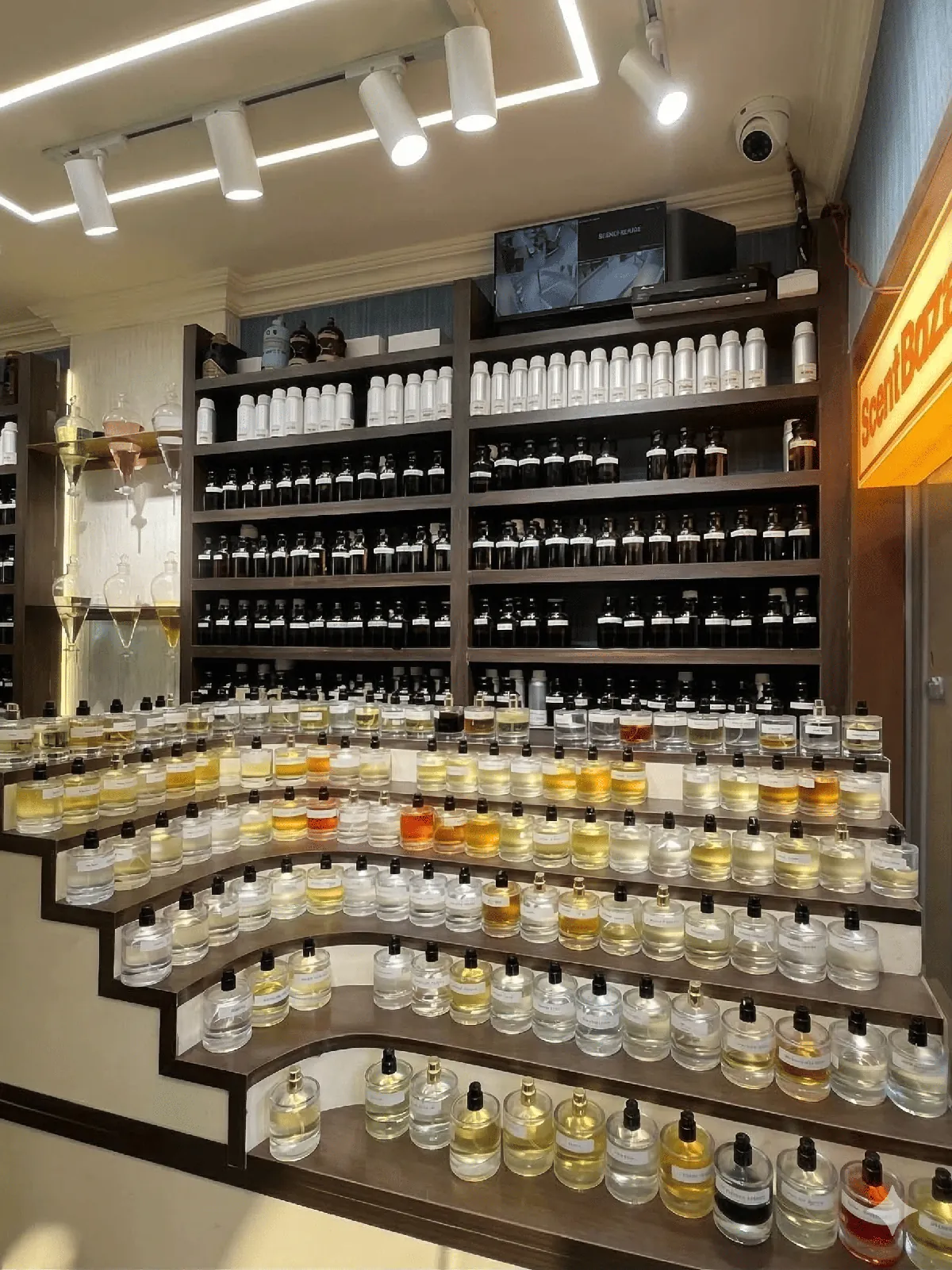
Scent Bazaar is positioned for buyers who want more than a shelf of fragrance oils. We serve businesses that need a perfume oil supplier in Dubai with practical B2B capability: low-barrier sampling, wholesale supply, application guidance, private label support, and export documentation.
That matters because many buyers are not simply buying a raw oil. They are trying to build or scale a fragrance business. They may need to compare Arabic and French scent directions, test a few concentration options, source perfumers alcohol, or move from loose oil supply into bottle-ready finished perfume. A fragmented supply chain makes that slower and more expensive.
What we offer
- 2,000+ fragrance oils across Arabic, French-inspired, musky, floral, gourmand, oud, and functional fragrance categories.
- Low MOQ access on stocked oils for testing and early-stage brand development.
- MSDS and COA support as standard, with additional export documentation where needed.
- Private label perfume, bottle sourcing, filling, and finishing support.
- Custom perfume blending for brands building proprietary fragrances.
Why buyers use us
- Fast communication from a Dubai base, which shortens decision cycles.
- Better commercial fit for startup brands and medium-size buyers that need flexibility, not factory-scale rigidity.
- Technical grounding through founder Nawar Mohammed's chemical engineering background.
- Ability to support fragrance selection through to finished-product execution.
This combination makes Scent Bazaar a strong fit for perfume startups, boutique retailers, export traders, hotel scent buyers, and established brands expanding into new scent lines. We are especially useful where the buyer wants to move quickly without sacrificing documentation quality or formulation conversation.
Commercially, our strongest positioning is not “lowest price in the market”. It is reducing the hidden costs around trial, revision, documentation, and launch execution.
A practical buyer checklist before you request quotations
If you want cleaner quotes and fewer sourcing mistakes, send suppliers a brief that answers the following points:
- What exact product are you making: spray perfume, oil perfume, bakhoor, candle, diffuser, soap, detergent, or cosmetic?
- Do you need stocked oils, custom blending, or both?
- What is your opening MOQ target for testing and what volume do you expect after validation?
- Which market will the finished product sell in: UAE only, GCC, Europe, Africa, or multi-country export?
- Which documents do you require before shipment?
- Do you need adjacent supply such as perfumers alcohol, bottles, caps, pumps, filling, or labeling?
- Do you need a scent family shortlist, or are you already asking for named fragrance directions?
Buyers that send a structured brief get better supplier responses. More importantly, they reveal which suppliers actually understand the job. A strong supplier will answer directly, identify gaps in the brief, and guide next steps. A weak supplier usually replies with a generic catalogue and leaves the buyer to figure the rest out.
Final verdict: how to choose the right perfume oil supplier in Dubai
If your business needs low-friction sourcing, fast coordination, lower initial MOQs, and stronger documentation support, a capable UAE supplier is usually the best first option. If your buying pattern is larger, more specialised, or heavily weighted toward traditional attar families, Indian suppliers can be commercially strong. If your operation is already procurement-heavy and QC-driven at scale, Chinese suppliers may also deserve evaluation.
But in nearly every case, buyers should shortlist suppliers based on commercial fit, not just catalogue size. The right perfume oil supplier is the one that can support your actual route to market: sampling, compliance, repeatability, and eventual scale.
That is why Scent Bazaar's model is built around both supply and execution. We help buyers source perfume oils in Dubai, compare scent directions intelligently, document shipments properly, and move toward finished commercial products when needed. For brands that want a supplier relationship rather than a one-off transaction, that is usually the better long-term decision.
Need a perfume oil supplier in Dubai that can actually support the next step?
Tell us what you are building and we will recommend suitable oils, discuss MOQ options, and advise on documentation or private label requirements. We work with startup brands, retailers, traders, and export buyers across the UAE and internationally.
About the author
Nawar Mohammed is the founder of Scent Bazaar and a chemical engineer with experience in fragrance chemistry, raw material sourcing, and product development for perfume, private label, and functional fragrance applications.